
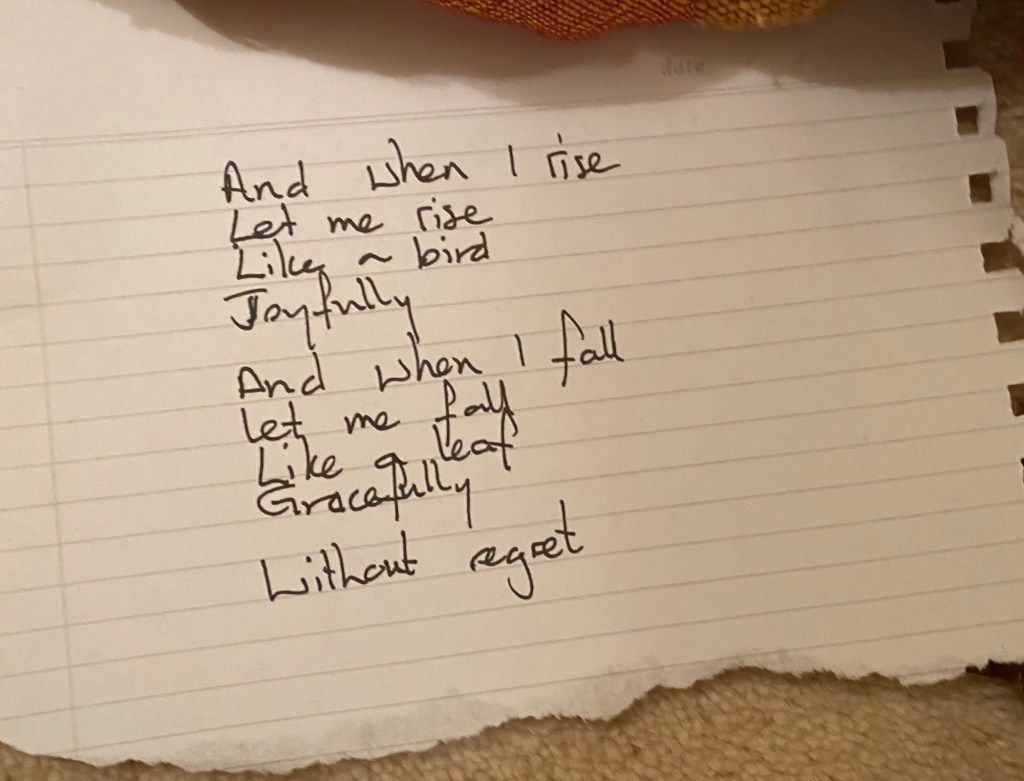
This post is about how we might live with and respond kindly to the sometimes huge and surrounding emotions we can feel in our lives. I wrote about how I have experienced them and their accompanying storylines in the previous post that ended with this from Pema Chodron.
“So whether it’s anger or craving or fear or jealousy – whatever it might be – the notion is not to try to get rid of it, but to make friends with it. That means getting to know it completely, with some kind of softness, and learning how, once you’ve experienced it fully, to let go.” Pema Chodron ‘The Wisdom of no Escape’ chapter 4.
“Not to try to get rid of it…” there’s the rub. Present moment dissatisfaction drives our whole economy, if not culture. Could you be still with the uncomfortable, the downright vile? A whole teaching and practice is right here. Pay attention to an object, when the mind contracts around something else, notice that, gently label it ‘thinking’ and precisely – yet kindly – invite the attention back to where you had intended it to be.
And do that for as long as it takes, and it will take long, to ‘experience it fully’. Don’t ask me how the letting go happens. I am not sure of the mechanics of that, but it will begin in its own time. There is a description of this type of meditation that says what we doing is slowly creating the conditions for letting go to occur without knowing if it will. But we continue intending to build the best conditions regardless of the outcome that day. Western Buddhists don’t like to talk that much about faith, so let’s call it trust. Trust that what we are doing sitting day after day will have, is having, a beneficial effect for the world around us even though a lot of the time we don’t know for sure that is the case. Imagine how grateful ‘20 years in the future’ you will be to ‘today’ you if you develop or maintain a daily routine that includes meditation. And imagine how grateful the ‘20 years in the future’ communities and environments you will be a part of will be toward the trust and faith you are placing in your meditation practice today in this very moment
“The main thing is that you’re showing up, that you’re here, and that you’re finding ever more capacity to love this world because it will not be healed without that.“ Joanna Macy
A further reason for maintaining that practice is how dam useful it is in moments when the gloom takes over. Right effort and intention have already been taking place. So even though it may well feel utterly impossible to do anything whilst the darkness is all around you, there may appear glimpses of a wider view and of a more spacious way of holding the pain; of ‘getting to know it completely’. Without those glimpses I am not sure it is possible to look at the feeling of gloom and say truthfully to yourself that it is okay for it to be here. And in the end it has to be okay for it be here. “I want to be in this moment, but not this moment.” Is not how it works. But, it’s easy for me to sit here now and completely believe in that statement, but at the time of darkness, I have to be honest and own up to say it is not like that at all. The feeling is completely “this should not be like that.” Should and should not are thoughts still present in my meditation.
I also find chanting or reciting mantras beneficial. It is important to know the meaning and origin of what you are saying. Many Buddhist centres will have information like this and also you can always join in a session to see what it feels like. I use a combination of the Heart Sutra, Medicine Buddha mantra (see a YouTube version below that I love) and a compassion mantra. But that is just what I know, there are many many more. If you like more English in what you are saying the then the forest sangha chanting may work better.
A friend of mine shared a technique that works for her when times are hard. She visualises each of the communities in which she is involved and surrounds herself with these images. She describes receiving an energy from this support. From a Buddhist viewpoint this is taking refuge in the Sangha (Buddhist community). Support is normally widened to also take refuge in the Buddha, the Dharma (the teachings and the way of living) as well as the Sangha. This is regularly chanted in the morning and before meditations and prayer sessions in most Buddhist lineages. You can lean on this support at any time and also if you wish imagine sharing that support with other living beings too.
The idea of offering out care and support in this way is included in a practice called Tonglen which translates as giving and sending and is a simple practice. It is a simple practice of sending out ‘good wishes’ on the outbreath and taking on hardship and pain from others on the in breath. Pema Chodron explains and guides it wonderfully here. For me what works with this attitude is that the suffering I am feeling is not unique to me. Other people undergo it too. I am not alone and what is more, when I feel strong enough to, I can visualise taking that darkness from them. The barriers between myself and living beings are smudged a touch. The idea that I, we, are not in this alone is not set in stone. Maybe it is possible that through these low times I am able to feel more connected and in harmony with the world. The gloom could be used for goodness. How indescribably wonderful would that be?
And finally I highly recommend allowing yourself to be cared for, held, hugged, hosted, fed, given mugs of tea and spoilt by your good friends. Let them in,accept their love. You don’t have to do anything except sit on their sofa. They have got your back. We are in this shit together. This last paragraph is dedicated to Joe, Amanda, Nic, Tracy and my children Finn, Brook and Elleree. I will lean on you more in the future I promise.
Here’s that lovely medicine Buddha mantra I promised

 trustingmind
Leave a comment